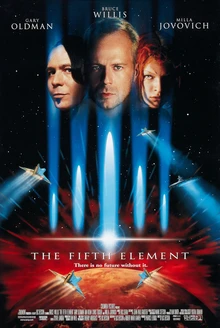
The President
In a city of flying cars and alien gods, one office still carries the weight of a nation.

The President is the head of state in the future New York City depicted in Luc Besson's 1997 sci-fi epic The Fifth Element. Set in the year 2262, the film presents a sprawling metropolis where ancient political institutions still operate beneath a canopy of flying vehicles, holographic billboards, and interstellar commerce. The President embodies that continuity — a figure of governmental authority who appears within the film's broader political and military apparatus.
Though a supporting presence, the role of the President helps ground the story's world in a recognizable power structure. In a city where a one-of-a-kind biological weapon could shatter the balance between Earth and the alien forces it was forged to counter, the President represents the institutional weight of the nation that must respond, coordinate, and ultimately protect its people.
- Character
- The President
- Role
- Head of State / Political Authority
- Affiliation
- Government of New York (2262)
- First appears
- The Fifth Element (1997)
- Status
- Supporting / minor on-screen role
- Setting
- Future New York City, year 2262
Lore & Background
The Fifth Element constructs its world with a deliberate blend of the familiar and the fantastical. New York in 2262 still has a President, a White House, and the trappings of a democratic republic, yet the skyline is threaded with vertical highways and the streets hum with a multicultural, multi-species population. This juxtaposition is one of the film's signature aesthetic choices: the political machinery of a recognizable nation-state persists even as the world has expanded into the stars.
The President's presence in the narrative serves a structural purpose. The central conflict — the gathering of four elemental beings to produce a fifth, one capable of annihilating the dark force — is not merely a spiritual or military affair. It is a matter of state security, diplomatic coordination, and the allocation of enormous resources. The President, whether shown directly or referenced through the bureaucracy that surrounds the military and intelligence branches, is the ultimate authority under which these operations unfold. The film's government officials, military commanders, and intelligence operatives all operate within a chain of command that traces back to that office.
Fans often note that the film's political layer is deliberately understated compared to its mythological and action set-pieces. The President is not a character with a personal arc or a memorable monologue; rather, the role functions as a symbol of institutional legitimacy. In a story where a cab driver, a one-eyed alien, a shapeshifting bounty hunter, and a prophetic priest must work together, the President is the reminder that the machinery of the state is still there, still trying to keep order while the world teeters on the edge of annihilation.
In Their Own Story
The chandelier sways gently in the draft from the sealed window, its crystal catching the amber glow of the late-afternoon sun filtering through the tall glass. The President stands at the head of the long table, hands clasped, listening to the briefing that has already been delivered twice. Outside, the vertical traffic lanes pulse like veins of light against the grey-blue sky, and somewhere below, in the tangled streets of a Manhattan that no longer fits on any old map, a cab driver is running red lights to save a woman who is, in the most literal sense, the end of the world. The President straightens the flag on the table, glances at the clock, and says nothing. There is nothing to say yet. The war room hums with the quiet industry of a nation that has learned, over two centuries of expansion, that the universe is larger than any single government — but that it still expects someone to pick up the phone when the sky starts to burn.
Reader's Guide
The President in The Fifth Element is a functional, institutional figure rather than a character driven by personal desire or conflict. In the film's 2262 New York, the office represents the continuity of Earth's political order in an age of interstellar travel and alien contact. The President does not pilot ships, deliver prophecies, or wield elemental powers; the role's significance is structural. The President anchors the government's response to the existential threat posed by the Dark Force, lending authority to the military and intelligence operations that form the backdrop of the main plot.
The character's motivation, insofar as it can be read, is the preservation of the state and its citizens. Every decision the President makes flows from that single, unglamorous imperative: keep the nation alive. This makes the role a quiet counterpoint to the film's more flamboyant characters — Korben's reluctant heroism, Leeloo's mythic destiny, Zorg's theatrical villainy. The President is the still point around which the chaos orbits.
Key relationships are institutional rather than personal: the President works through advisors, military commanders, and intelligence operatives. The character does not share a scene of emotional intimacy with the protagonists; the connection is one of jurisdiction and responsibility.
As a fan note, the role is a small one by the film's standards, and much of the President's presence is felt through the set design and production design of the governmental spaces rather than through extended dialogue. The performance is deliberately measured and formal, reinforcing the idea that this is a figure of office first and individual second. In the broader context of the film, the President is a reminder that even in a universe of gods and monsters, someone has to sign the paperwork.
Did You Know?
- The Fifth Element's New York is set in the year 2262, yet the city retains recognizable institutions like the Presidency, blending futuristic spectacle with familiar American political architecture.
- The film's production design gave governmental and military spaces a deliberately 'lived-in' look, with cluttered desks and worn surfaces, to contrast with the sleek, alien aesthetics of the other factions.
- Luc Besson has described The Fifth Element as a 'modern myth,' and the presence of an earthly head of state alongside prophetic and elemental figures underscores that blend of the political and the mythic.
- The President's role, while small, is essential to the story's logic: the gathering of the four elements and the confrontation with the Dark Force require state-level coordination, resources, and authority that only the
More in Characters & Cast
Elsewhere in the The Fifth Element universe
Spotted an error? Know more?
This is a living reference — every entry is fact-audited, and reader corrections feed straight into our audit queue. Suggest an edit · See this site's audit record