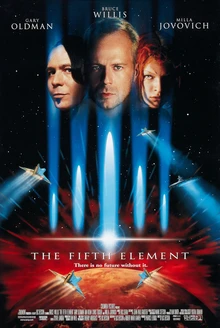
Prophecy of the Great Evil
A five-thousand-year cycle of cosmic darkness demanding a singular elemental salvation.

Spicer, William Ambrose, 1866- · No restrictions
The Prophecy of the Great Evil is the ancient, cyclical warning that anchors the entire narrative of The Fifth Element universe. It foretells a recurring cosmic threat known as the 'Great Evil,' an entity so destructive it can consume all life in existence if not stopped. This prophecy dictates that every five thousand years, this darkness returns to attempt universal annihilation, necessitating a specific countermeasure.
- First Mentioned In
- The Temple on Earth
Lore & Background
To combat this inevitable return, the Mondoshawan created four elemental stones, each representing a fundamental aspect of existence, designed to be combined with a fifth, living element that embodies life itself. The prophecy states that only when these five components unite can they generate enough power to seal away or destroy the Great Evil. This knowledge was passed down through generations until it reached the hidden temple on Earth, where the final piece—a living being named Leeloo—was kept in a containment chamber, waiting for its destined moment.
In Their Own Story
The air in the lunar temple is thin and cold, smelling of ancient stone and ozone. A lone monk stands before a glowing pedestal, his eyes reflecting the swirling red vortex visible through the high archway—the Great Evil approaching Earth once more. He whispers the old words, not in fear, but with the weight of five thousand years of waiting. 'It is time,' he murmurs, watching the stars dim as the shadow grows. Somewhere on a distant planet, a flower blooms, and on a crowded street in New York, a woman wakes from a dream she has never had before.
Reader's Guide
The prophecy relies heavily on the concept of cyclical time rather than linear history. The universe does not progress toward a final end but loops through destruction and rebirth every five thousand years. This suggests that civilizations have risen and fallen many times, each unaware they are merely one iteration in an eternal struggle against the Great Evil. The distinction between the 'elements' is crucial; while fire, water, earth, and air represent physical forces, the Fifth Element is unique because it is a living being capable of choice and love. The prophecy implies that the Great Evil cannot be defeated by force alone but requires a synthesis of matter and spirit. Hidden within the lore is the idea that the Monks are not just guardians but architects of this salvation. They did not merely predict the end; they actively engineered the biological key to stop it, hiding it in plain sight as a human-like entity until the stars aligned for its activation.
Did You Know?
- The five thousand-year cycle marks the timing of the Great Evil's return, not a requirement for its manifestation.
- The Monks did not create the defense mechanism; the Mondoshawan created the four elemental stones and Leeloo as the fifth element.
- The four physical stones are hidden in a vault and brought to the temple later, not stored there waiting.
- If the prophecy fails and the five elements do not unite, the Great Evil will consume all life in the universe without exception.
Origins and Mythic Framework
The narrative establishes a world where avian kingdoms face an existential threat from prehistoric archaeopteryxes, led by the tyrannical Hungrias the Second. This conflict forces King Pepheroh of the magical sanctuary Kauria to forge a legendary weapon under divine instruction. The resulting Hero Sword becomes central to a prophecy involving seven Leasorn Gems, each representing a rainbow color and scattered globally as clues to the sword's location. A specific timeline dictates that a destined hero must claim this blade at the fifth full moon three years later to restore peace. However, the stakes are raised by the presence of Yin Soul, a four-winged entity trapped between life and death who seeks possession of a worthy host to escape his torment. This setup creates a high-stakes environment where the survival of birdkind depends on preventing these artifacts from falling into evil hands while navigating a landscape fractured by war and slavery.
The Hero's Journey and Companions
Wind-Voice, a dove hatchling born after his mother escapes a massacre, emerges as the central protagonist despite starting life as a slave. His path to heroism begins when he rescues Winger, an imprisoned woodpecker scribe, leading them through dangerous encounters with archaeopteryx guards and the spectral realm of Yin Soul. Alongside Fisher, a battle-scarred crane who teaches swordsmanship, and Stormac, a treasure-obsessed myna, Wind-Voice embarks on a quest to locate the scattered gems. Their journey spans diverse environments from swamps to deserts, where they face mortal peril; Stormac is mortally wounded but healed by parrots using a green gem, while Winger and Fleydur, an exiled golden eagle prince, venture toward penguin lands. The group's dynamic evolves through shared trauma and the revelation of hidden identities, such as Fleydur's royal lineage and Wind-Voice's own latent potential to resist supernatural manipulation.
Antagonists and Political Intrigue
The primary antagonists are driven by ambition and supernatural corruption, most notably Sir Maldeor. Initially a knight serving Hungrias, Maldeor loses his son Prince Phaethon to Yin Soul during a failed mission against the doves. Betrayed and exiled for this failure, Maldeor is later resurrected by Yin Soul with a bat-like wing that requires monthly sustenance from a dark potion. This alliance allows him to usurp the throne of Hungrias and establish a new empire of slavery, turning even strong species like crows into servants. The conflict escalates as Maldeor attempts to execute Wind-Voice multiple times, only for the hero to survive through sheer resilience. Ultimately, Yin Soul's attempt to control Maldeor fails, leaving the dark emperor to lead his forces in a final assault on Kauria, driven by a desperate need to secure power before his supernatural patron abandons him.
Resolution and Enduring Legacy
The climax unfolds at Kauria where Wind-Voice confronts Maldeor amidst a crumbling temple. Although Maldeor wields a false sword, the true Hero Sword manifests in Wind-Voice's claws during the battle, leading to Maldeor's death as the structure collapses. Following this victory, the archaeopteryx forces disperse to form their own tribes, and Fleydur is reunited with his family. King Pepheroh renames Wind-Voice 'Swordbird' and reveals his divine parentage as the son of the Great Spirit. The Leasorn Gems lose their magical clues, and the day of this victory becomes the Bright Moon Festival. In a poignant twist, Swordbird appears to Winger in a dream, revealing he perished in the rubble but now exists as a spirit guardian dedicated to maintaining peace for those who summon him.
Gallery
Frequently Asked Questions
What is the Prophecy of the Great Evil?
It is an ancient warning that predicts a recurring cosmic threat capable of destroying all life every five thousand years. This cycle demands a specific elemental solution to prevent universal annihilation.
Who originated this prophecy?
The prediction was established by the Ancient Monks residing at the Temple on the Moon long before modern civilization existed. They foresaw the cyclical nature of the darkness and prepared the necessary countermeasures accordingly.
How often does this threat occur?
The Great Evil arrives on a strict schedule, reappearing once every five thousand years to attempt total destruction. Each cycle requires humanity or its guardians to be ready with the prophesied defense.
What stops the Great Evil from destroying the universe?
Salvation requires combining the Four Elements with a living being known as the Fifth Element to create an indestructible weapon. This singular force is the only thing capable of defeating the Mega-Entity when it returns.
Why is this prophecy central to the film's story?
It drives the entire plot by forcing characters like Korben Dallas and Leeloo to unite against an impending apocalypse. Without fulfilling this ancient warning, Earth faces immediate extinction from the approaching darkness.
More in Lore & History
Elsewhere in the The Fifth Element universe
Spotted an error? Know more?
This is a living reference — every entry is fact-audited, and reader corrections feed straight into our audit queue. Suggest an edit · See this site's audit record