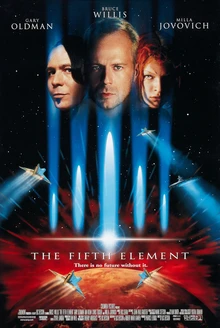
Earth Stone
One of the four engraved stones representing the classical elements.

The Earth Stone is one of four mystical stones essential for the defence of Earth against the impending attack of a malevolent cosmic entity. The stones are described as four engraved stones representing the four classical elements. They are part of a weapon that consists of the four classical elements, as four engraved stones, plus a sarcophagus containing a "fifth element".
- Type
- Elemental Artifact
- Element
- Earth
Verified Timeline
Lore & Background
The stones were originally entrusted to an alien opera singer, the diva Plavalaguna, after the Mondoshawan spacecraft carrying the weapon was ambushed and destroyed. The stones were not on board the Mondoshawan ship. During a concert on the planet Fhloston, the Mangalores attack, and Plavalaguna is killed. Dallas extracts the stones from her body. Zorg arrives, shoots Leeloo, and activates a time bomb. He flees with a carrying case which he presumes contains the stones, but returns when he discovers that it is empty. Dallas escapes with Leeloo, Cornelius, Rhod, and the stones in Zorg's private spaceship.
In Their Own Story
As the great evil approaches Earth, the four meet David at the temple. They deploy the stones, but Leeloo, having learned of humanity's history of cruelty, has given up on life. Dallas declares his love for her and kisses her. Leeloo combines the power of the stones, emitting divine light onto the great evil and defeating it.
Reader's Guide
The four stones represent the four classical elements. They are engraved stones. The weapon consists of these four stones plus a sarcophagus containing a "fifth element" (Leeloo). The stones were not on board the Mondoshawan ship when it was destroyed; they had been entrusted to the diva Plavalaguna. Dallas extracts the stones from Plavalaguna's body after she is killed during the Mangalore attack. The stones are deployed at the temple by the group. Leeloo combines the power of the stones, emitting divine light onto the great evil and defeating it.
Did You Know?
- The Earth Stone is one of four engraved stones representing the four classical elements.
- The stones were not on board the Mondoshawan spacecraft when it was destroyed; they had been entrusted to the diva Plavalaguna.
- Dallas extracts the stones from Plavalaguna's body after she is killed during the Mangalore attack.
- Leeloo combines the power of the stones to emit divine light onto the great evil and defeat it.
Origins and Production Challenges
Luc Besson conceived the narrative foundation for this science fiction epic at the tender age of sixteen, yet it took him two decades to bring the vision to life. By the time the film premiered in cinemas when he was thirty-eight, the project had evolved into a massive undertaking that required international collaboration. Although Besson initially intended to shoot entirely within France, the lack of suitable facilities forced a relocation of production to London and Mauritania. To capture the unique aesthetic he desired, Besson enlisted legendary comic artists Jean Giraud and Jean-Claude Mézières for production design, drawing direct inspiration from their graphic novels. The film's distinctive visual identity was further cemented by costume designer Jean Paul Gaultier. These creative decisions contributed to the film becoming the most expensive European production ever made at its release, a testament to the ambitious scope required to realize Besson's long-held dream of depicting Earth's survival in the twenty-third century.
Narrative Arc and Mythological Stakes
The story spans centuries, beginning in 1914 when aliens known as Mondoshawans entrust an ancient Egyptian priest with a weapon capable of defeating a cyclical cosmic evil. This weapon comprises four elemental stones and a sarcophagus holding the 'fifth element.' In the twenty-third century, this dormant threat awakens as a living fireball, prompting a desperate race to recover the scattered components. The plot centers on Korben Dallas, a former special forces major turned taxi driver, who inadvertently becomes humanity's savior after Leeloo, the resurrected fifth element, crashes into his vehicle. Together with priest Vito Cornelius and the flamboyant Ruby Rhod, they must retrieve the stones from an alien opera singer while evading the machinations of industrialist Zorg. The climax sees Dallas rekindling Leeloo's faith in humanity through love, allowing her to channel the stones' power into a divine light that annihilates the approaching evil.
Critical Reception and Financial Triumph
Upon its release, the film polarized critics, garnering both high praise and scathing negative reviews. Despite this mixed critical reception, it achieved significant recognition at major ceremonies including the British Academy Film Awards, César Awards, Cannes Film Festival, and Lumière Awards. Conversely, it also faced nominations for the Golden Raspberry and Stinkers Bad Movie Awards, highlighting its divisive nature among audiences and reviewers alike. Financially, however, the project was an undeniable powerhouse. Produced on a ninety-million-dollar budget, it grossed over two hundred sixty-three million dollars globally, securing its place as the ninth highest-grossing film of 1997. For fourteen years following its debut, it held the record as the highest-grossing French film internationally until surpassed by The Intouchables in 2011.
Thematic Depth and Gender Critique
While director Luc Besson described the project as lacking a singular 'big theme,' he aimed to provoke reflection on humanity's worthiness of survival, specifically through Leeloo's cynical inquiry about saving life given human cruelty. Scholars have identified political corruption as a key undercurrent within the narrative landscape. However, the film has faced substantial criticism regarding its portrayal of gender dynamics. Feminist analysts argue that women are largely erased or marginalized in the opening sequences and frequently depicted as passive objects or hyper-sexualized figures throughout the runtime. Critics note that female characters often lack agency, serving primarily as visual spectacles or stripped of traditional femininity, thereby reinforcing stereotypical beliefs about gender roles rather than subverting them within this futuristic setting.
Frequently Asked Questions
What is the Earth Stone?
This artifact counts as one of the four holy crystals vital to the movie's lore regarding the Great Evil. Its rough, earth-toned appearance symbolizes the grounding force necessary for cosmic stability.
Who protects the Earth Stone?
The Monks of the Ancient Order served as its protectors for many generations before the final conflict began. They ensured it remained secure until the specific moment required to activate Leeloo's powers.
What is the function of the Earth Stone?
It operates as a channel for energy that stabilizes the larger forces needed to fight the enemy. This grounding capability allows the Fifth Element to harness sufficient strength against the threat.
Why is this artifact critical to the story?
Without this specific crystal, Leeloo cannot fully unlock her potential abilities to save humanity. It acts as a necessary component in restoring the balance required to defeat the Great Evil.
Where does the Earth Stone end up by the finale?
During the climax of the film, this crystal is brought to the President's Ship Bridge for use. It remains there until the mechanism successfully repels the incoming cosmic disaster.
More in Powers & Artifacts
Elsewhere in the The Fifth Element universe
Spotted an error? Know more?
This is a living reference — every entry is fact-audited, and reader corrections feed straight into our audit queue. Suggest an edit · See this site's audit record