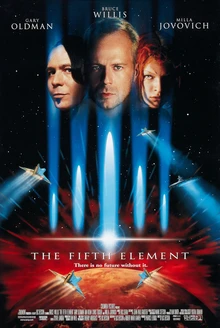
Good Versus Entropy
The universe unravels every five millennia; goodness is the act that stitches it back together.

Good Versus Entropy is the central metaphysical conflict of Luc Besson's 1997 sci-fi epic The Fifth Element. The film frames the universe as a perpetual tug-of-war between two absolute forces: the One, a cosmic agent of pure destruction and unmaking, and the Fifth Element, a being of pure creation and life. Rather than presenting a simple moral duel, Besson casts the struggle as an almost thermodynamic law—entropy is not merely evil but the natural tendency of the cosmos to dissolve, while goodness is the active, improbable force that rebuilds order and meaning.
This theme shapes every layer of the film: its cyclical plot structure, its saturated visual palette (warm color for life, cold void for the One), and its ultimate message that goodness is not a default state but a choice that must be renewed each time the cycle turns. The audience is invited to see the hero's small, human acts of compassion as the cosmic counterweight to an ancient, inevitable unraveling.
- Theme
- Goodness as active creation vs. entropy as passive dissolution
- Antagonist force
- The One (a cosmic agent of pure evil)
- Counterforce
- The Fifth Element (Leeloo)
- Cycle interval
- Approximately 5,000 years between the One's returns
- Setting
- 2259, New York City and surrounding space
- Director
- Luc Besson
- Release year
- 1997
Lore & Background
In the cosmology Besson builds, the One is not a character with backstory or motive in the traditional sense. It is a force, a void, a gravitational pull toward dissolution. When it appears, it does not conquer so much as erase—planets, civilizations, the very fabric of matter simply cease. The film's opening establishes this with almost documentary coldness: the One arrives, and what was is gone. There is no negotiation, no ideology, no malice. It is entropy made manifest, the second law of thermodynamics given a face of absolute black.
The Fifth Element is its precise inverse. Leeloo, as the embodiment of pure good, does not fight the One with weapons or strategy. Her power is generative: she heals, she creates, she turns chaos into life. The film's climax is not a battle in the conventional sense but an act of creation so total that it rewrites the rules of the conflict. Besson positions goodness not as a shield against entropy but as a creative act so powerful it restructures reality around itself.
Crucially, the cycle does not end. The film's closing images make clear that the One will return, that the balance will tip again. This is not a failure of the narrative but its thesis: goodness is not a permanent victory but a recurring choice. Every generation must choose to create, to heal, to build, or the void simply wins by default. The theme thus becomes an argument for active, repeated moral effort over passive optimism.
In Their Own Story
The corridor on the spaceship hums with the low thrum of engines, a sound Korben Dallas has felt in his molars for what feels like years. Through the porthole, the One is not visible—there is nothing to see. It is the absence of seeing. The stars beyond the glass simply stop, as if the light itself has been politely asked to leave. Leeloo stands at the center of the room, her arms spread, and where her fingers point, color bleeds back into the void. Not light, exactly. Something warmer. The kind of warmth that smells like bread and sounds like a child laughing in another room. The One does not rage. It recedes, the way a tide recedes, because the shore has been rebuilt. Korben watches the color spread and thinks, not for the first time, that the universe is not a machine. It is a choice, made over and over, in every small hand that reaches out to mend what the dark has torn.
Reader's Guide
The Good-versus-Entropy theme is the film's structural spine, and Besson encodes it in three distinct layers.
First, the visual language. Every scene involving the One is drained of color—flat blacks, sterile whites, the suggestion of a void where matter should be. By contrast, Leeloo's scenes are drenched in saturated reds, golds, and greens. Besson is not merely decorating; he is arguing that goodness is sensory, embodied, alive, while entropy is the absence of sensation itself.
Second, the plot's circularity. The film opens with the One's previous arrival and closes with the implication of its next one. The 5,000-year cycle means the story is not a line from problem to solution but a loop. The hero does not defeat entropy permanently; he reasserts the possibility of goodness for one more rotation. This mirrors the film's own structure: the act of creation at the climax does not end the story but resets the conditions for the next act of creation.
Third, the philosophical framing. Besson rejects the idea that good is the default state of the universe. Entropy is the path of least resistance; goodness requires energy, effort, choice. The film's small, human moments—Korben's clumsy kindness, Ruby Rhod's impulsive loyalty—are presented as cosmically significant because they are acts against the grain. The structure says: the universe leans toward dissolution, and every small act of repair is a rebellion worth celebrating.
Did You Know?
- The film's 5,000-year cycle between the One's returns means the narrative is explicitly cyclical rather than linear—the ending resets the conditions for the next confrontation rather than resolving it permanently.
- Besson's visual design deliberately strips all color and warmth from scenes involving the One, treating entropy as the absence of sensory experience rather than a presence of dark energy.
- The 'Fifth Element' concept draws on the alchemical and philosophical idea of quintessence—a fifth, spiritual substance beyond the four classical elements—positioning goodness as a transcendent force rather than a mere m
- The film's climax is structured as an act of creation rather than destruction: the resolution rewrites the rules of the conflict rather than simply eliminating the antagonist, reinforcing the theme that goodness builds r
More in Themes & Symbolism
Elsewhere in the The Fifth Element universe
Spotted an error? Know more?
This is a living reference — every entry is fact-audited, and reader corrections feed straight into our audit queue. Suggest an edit · See this site's audit record