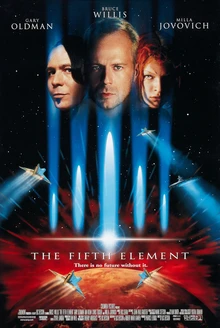
Leeloo's Healing Touch
One touch rewrites the body's verdict, and death itself has to wait its turn.

Leeloo's Healing Touch is the innate regenerative and restorative ability of Leeloo, the Fifth Element, as depicted in Luc Besson's 1997 film. Rooted in her nature as a being of pure, living energy, the power allows her to mend living tissue and restore health simply through physical contact. It is not a device, a spell, or a learned technique—it is simply what she is, an expression of the elemental force that makes her the final piece in the cosmic balance between life and death.
On screen, the Healing Touch serves as one of the clearest visual demonstrations that Leeloo is not merely a person but a force of nature. It underscores the film's central theme: that life, in its purest form, is both creative and irrepressible. Whether she is mending a wounded companion or reconstituting her own shattered body, the ability reminds the audience—and the characters—that the Fifth Element cannot be contained, catalogued, or destroyed by conventional means.
- Wielder
- Leeloo (the Fifth Element)
- Type
- Innate elemental ability
- Affiliation
- The Fifth Element / Cosmic balance of life and death
- First appears
- The Fifth Element (1997)
- Mechanism
- Physical contact; no tools, devices, or incantations required
- Status
- Active and demonstrated multiple times in the film
- Limitations shown
- Appears to require direct skin-to-skin contact; not depicted as remote or area-wide
Lore & Background
In the cosmology of The Fifth Element, the universe is held in check by a cycle of creation and destruction. Every six thousand years, the four existing elements align to permit the birth of a fifth—a being of concentrated, self-sustaining life-energy. Leeloo is that being. Her Healing Touch is not a skill she acquired; it is the natural byproduct of her existence. Where her fingers press against a wound, the tissue remembers what wholeness looks like and rebuilds. The film presents this without technical explanation, treating it the way one treats a sunrise: it simply is, and to question its mechanism is to miss the point.
The ability is shown in intimate, almost tender moments rather than grand battle sequences. Leeloo heals a wounded companion in the cramped, cluttered apartment that serves as the crew's temporary base, her small hands working over bruised and broken flesh while the others watch in stunned silence. Later, when her own body is destroyed, the same regenerative principle reasserts itself—she reconstitutes from fragments, her form knitting back together as though the universe refuses to let the equation remain unbalanced. The contrast between the Mute's passive, sensory gifts (hearing across distances, seeing through solid matter) and Leeloo's active, creative power highlights a deliberate thematic pairing: one element perceives, the other restores.
What makes the Healing Touch resonate with audiences is its simplicity and its defiance of the film's otherwise hyper-technological world. In a setting of plasma rifles, hover-taxis, and corporate war machines, Leeloo's most profound act is to put her palm on someone's cheek and say, in effect, 'you are allowed to keep living.' It grounds the cosmic stakes in something as old and universal as a mother's hand on a fevered brow.
In Their Own Story
The apartment smells of burnt toast and gunpowder. Korbey is slumped against the kitchen tile, a dark bloom spreading across his shirt where the bullet found him. He's counting his own heartbeat the way a man counts coins he can't afford to spend. Leeloo kneels. She doesn't speak—she never needs to. Her fingers, cool and impossibly steady, press into the wound. The blood stops. The color returns to his lips in slow, visible waves, like ink retreating from paper. He blinks at her. She blinks back, as if she's done something mildly inconvenient, like folding a shirt. Outside, the city hums its chrome lullaby. Inside, a man who was dead thirty seconds ago is alive again, and no one has a name for why.
Reader's Guide
On screen, Leeloo's Healing Touch is presented as an innate, elemental power rather than a manufactured gadget. It requires no weapon, no console, no spoken formula—only her hands making contact with living tissue. The film shows her mending a wounded companion in the apartment sequence and, in a separate beat, reconstituting her own body after it has been destroyed, confirming that the regenerative principle works both outward (healing others) and inward (self-repair).
Rules and limits as depicted: the power appears to require direct physical contact; it is never shown working at a distance or across a barrier. It mends biological damage—cuts, bullet wounds, broken tissue—but the film does not demonstrate it reversing, say, radiation poisoning or a severed limb in a single gesture. The pacing of healing is quick but not instantaneous; there is a visible process, a few seconds of her hands working, which keeps the moment grounded rather than cartoonish.
Narrative function: the touch is Leeloo's most humanizing power. In a film saturated with spectacle—chase sequences, space battles, corporate conspiracies—the Healing Touch is the quiet, intimate beat that reminds the audience why the Fifth Element matters. It is the film's argument that life is not a resource to be hoarded by the powerful but a gift to be given freely. It also creates dramatic irony: the characters who can destroy with technology cannot destroy what heals with a touch, making Leeloo both the most vulnerable and the most invincible figure in the story. Unlike the Mute's sensory gifts, which are passive and observational, or the Diamond Dog's manufactured combat role, the Healing Touch is active, creative, and irreducible to any machine.
Did You Know?
- Leeloo's Healing Touch is never attributed to a training, a device, or a genetic modification in the film; it is presented as an inherent aspect of her existence as the Fifth Element, a being of pure life-energy.
- The same regenerative principle that lets her heal others also allows her to reconstitute her own body after destruction, suggesting the power is a single unified ability expressed in two directions: outward and inward.
- The Mute (the 'President') possesses a separate set of innate sensory powers—enhanced hearing and sight—but no healing ability, underscoring that each element's gifts are distinct and non-transferable.
- The film never provides a scientific or technical explanation for the Healing Touch; it is treated as a natural law of the universe's elemental cycle, closer to a phenomenon than a superpower.
More in Powers & Artifacts
Elsewhere in the The Fifth Element universe
Spotted an error? Know more?
This is a living reference — every entry is fact-audited, and reader corrections feed straight into our audit queue. Suggest an edit · See this site's audit record