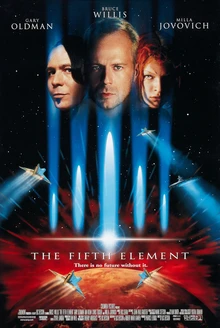
The Four Elements
Four scattered forces converge into one, and the cycle breathes again.

In the mythological architecture of Luc Besson's 1997 film, the Four Elements—Earth, Water, Fire, and Air—are ancient, semi-divine forces scattered across the cosmos. They exist in a state of dormancy until the 5,000-year cycle demands their activation. Their singular purpose is to merge with the Fifth Element, Leeloo, to forge the 'Perfect Being,' a composite entity of pure creative power capable of annihilating the Ankh Morporkor, the cyclical embodiment of cosmic entropy.
This framework is not mere backdrop; it is the engine of the entire narrative. Every character's arc, every chase through the neon-drenched streets of 23rd-century New York, and every act of sacrifice in the film funnels toward one moment of convergence. The Four Elements give the story its mythic weight, transforming a sci-fi action plot into a parable about wholeness, completion, and the necessity of every part in a living whole.
- Concept
- Central mythological framework driving the plot
- Elements
- Earth, Water, Fire, Air (plus the Fifth Element, Leeloo)
- Cycle length
- 5,000 years
- Purpose
- Unite to form the Perfect Being and defeat the Ankh Morporkor
- Climactic form
- The Perfect Being (combined state of all five)
- Narrative structure
- Circular—begins and ends aboard a spaceship in transit
Lore & Background
The mythology presented in the film positions the universe as a living system governed by a rhythmic alternation between creation and destruction. Every five millennia, the Ankh Morporkor—a vast, formless, tentacled embodiment of negation—surfaces to unmake all life. The only counterforce is the Perfect Being, which can only exist when the four classical elements and the Fifth Element are united in a single, coherent whole. The elements are not merely powers; they are distinct presences, each embodying a fundamental aspect of existence. Earth grounds, Water flows, Fire transforms, Air carries. None is sufficient alone. Their separation is the universe's vulnerability; their union is its salvation.
The film treats this cycle not as a distant legend but as an active, present danger. The elements are dormant, scattered, waiting. The narrative's urgency comes from the fact that the Ankh Morporkor has already arrived, and the window for reassembly is closing. This transforms the myth from abstract cosmology into a ticking clock, a race against entropy. The characters are not heroes who choose to save the world; they are cogs in a mechanism that has been winding down for five thousand years, and the story is the moment the mechanism finally engages.
The thematic resonance extends beyond the plot. The Four Elements mirror the film's own structural logic: disparate, colorful, almost chaotic individual storylines (a bumbling cop, a washed-up soldier, a mysterious woman, a bickering cab driver) that must coalesce into a single, purposeful motion. The city itself—layered, vertical, a palimpsest of cultures and technologies—functions as a visual metaphor for the elements in their scattered state, each stratum distinct, none yet unified.
In Their Own Story
The chamber hums with a frequency that has no name in any human language. Four presences—dense as stone, liquid as tide, searing as starlight, weightless as breath—drift toward the center of the void. They do not speak. They do not need to. They recognize each other the way a chord recognizes its intervals. And then the Fifth arrives, small and luminous and impossibly alive, and the four fold inward, not consuming her but completing her, the way a key completes a lock. For one suspended instant, the universe holds its breath. Then the Perfect Being opens its eyes, and the Ankh Morporkor, for the first time in five thousand years, feels something it has no name for: opposition. The void shudders. The cycle, ancient and patient, exhales.
Reader's Guide
The Four Elements theme operates on two simultaneous levels: the explicit myth and the structural architecture of the film. Besson uses the 5,000-year cycle to impose a circular shape on what is, on the surface, a linear action plot. The film opens with a spaceship in transit and closes with a spaceship in transit. The Ankh Morporkor's arrival is not a beginning but a recurrence. The Perfect Being's victory is not an ending but a reset. This circularity mirrors the elements' own nature: they are not created or destroyed, only scattered and reassembled. The plot is the reassembly.
Specifically, the four elements appear as distinct, almost abstract presences in the convergence sequence, each visually coded to its domain—earthy solidity, fluid motion, incandescent energy, gaseous diffusion. Besson does not give them dialogue or backstory; they are archetypes, not characters. This is a deliberate choice. They represent the idea that completion requires more than the sum of its parts. Leeloo, the Fifth, is the catalyst, but she cannot act alone. The 'I love you' motif that threads through the film's romantic subplot is, in Besson's symbolic logic, the binding agent—the human-scale emotion that makes the cosmic-scale merger possible. Love is the Fifth Element's way of saying that the universe needs not just power but connection.
The theme also critiques the film's own world. The 23rd-century city is a monument to excess, fragmentation, and individualism—every stratum competing for attention, every culture a separate island. The Ankh Morporkor is what happens when that fragmentation goes unchecked: pure negation, the absence of form. The Perfect Being is the antithesis: total integration. Besson is arguing, in visual and narrative terms, that a society which cannot unify its parts is one cycle away from annihilation.
Did You Know?
- The film's narrative is deliberately circular: it opens and closes aboard a spaceship in transit, visually encoding the 5,000-year cycle as a loop rather than a line.
- The four element beings are presented as abstract, non-verbal presences rather than named characters with backstories, emphasizing their role as archetypal forces rather than individuals.
- The Ankh Morporkor is depicted as a formless, tentacled mass of pure negation—a visual antithesis to the structured, colorful geometry of the Perfect Being, reinforcing the creation-versus-entropy theme.
- The 'Perfect Being' sequence is the only moment in the film where all five elements exist as a single visual entity, making it the narrative and symbolic apex of the entire story.
More in Themes & Symbolism
Elsewhere in the The Fifth Element universe
Spotted an error? Know more?
This is a living reference — every entry is fact-audited, and reader corrections feed straight into our audit queue. Suggest an edit · See this site's audit record