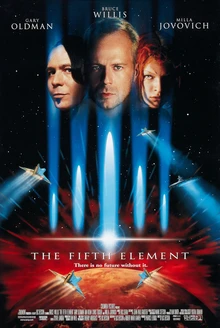
The Ankh
A tiny golden key that holds the birth of a new universe in its loop.

The Ankh is a small, golden, ankh-shaped sacred artifact at the heart of the Fifth Element's cosmology. Carried and guarded by the order of Priests, it functions as the literal key that unlocks the Fifth Element's power to end the old universe and birth a new one. Without it, the reunion of the four elemental beings with Leeloo would be merely a gathering, not a creation event.
In the film's mythos the Ankh is treated with the reverence of a holy relic—never spoken of casually, kept in the temple, and central to the ritual that the entire plot of 2259 revolves around. It is the one object that transforms a cosmic convergence into an actual act of universal renewal.
- Type
- Sacred artifact / Cosmic key
- Shape
- Ankh (looped cross)
- Appearance
- Small, golden, metallic
- Custodians
- The Priests
- Function
- Activates the Fifth Element's universe-creation power
- First appears
- Temple scene, 2259
- Status
- Central MacGuffin; fate of the universe depends on it
Lore & Background
In the theology of the Priests, the Ankh is not merely a symbol but a mechanism—a physical key that, when presented to the Fifth Element in the presence of the four elemental beings, triggers the death of the current universe and the simultaneous creation of a new one. The Priests describe it in hushed, ritual language, treating the object as both sacred and dangerous. Its power is passive until the precise convergence of all five elements occurs; at that moment the Ankh channels the creative force outward.
The Ankh's design echoes ancient Egyptian iconography, lending the film's mythology a deliberately archaic, cross-cultural weight. In a universe of sleek starships and holographic billboards, the Ankh is deliberately primitive in form—a loop and a cross, no larger than a hand. This contrast is central to the film's theme: the most consequential force in the cosmos is carried in the smallest, oldest-looking object. The Priests guard it not because it is powerful in isolation, but because in the wrong hands—or absent at the critical moment—it could mean the difference between renewal and eternal stasis.
Zorg's entire operation in 2259 is, at its core, an attempt to seize the Ankh and the Fifth Element for his own purposes, while the Priests and their allies work to ensure the ritual is completed correctly. The Ankh thus sits at the fulcrum of every major conflict in the story: it is the prize, the key, and the reason the universe is about to end or be reborn.
In Their Own Story
The temple smells of incense and old stone, a contradiction in a city of glass and neon. The High Priest lifts the Ankh from its velvet cradle, and the golden loop catches the light from a dying star visible through the dome. He turns it slowly, the way one would turn a key in a lock the size of a galaxy. Outside, the four elements stir in their respective corners of the city—Murdac's guilt, Ruby's oil-slick patience, Zorg's cold ambition, Kbale's thunderous loyalty—all of them unknowing pieces in a mechanism older than their species. The Priest whispers the old words, not a prayer but an instruction manual for entropy. The Ankh hums, just barely, a frequency below hearing. Somewhere below the city, in a cell that smells of blood and starlight, Leeloo presses her palm to the wall and feels, for the first time, that the universe is holding its breath for her.
Reader's Guide
Fragments recovered from the Priests' oral tradition, cross-referenced with the 2259 temple records:
Long before the current universe took its present form, the Ankh was forged—or perhaps simply *found*—by the first order of Priests. The texts disagree on whether it was made or discovered, but all agree it predates the four elemental lineages. It was kept in the temple, passed hand to hand through generations, and its purpose was sealed in ritual language: it is the key that turns when all five are one.
The last recorded activation of the Ankh's full power occurred in the previous cosmic cycle, an event the Priests reference only as "the Last Turning." The details are fragmentary, passed down in song rather than text. What is stated explicitly in the 2259 temple briefing is that the Ankh requires the simultaneous presence of Earth, Water, Fire, Air, and the Fifth Element. Absent any one, it is inert gold.
In 2259, the Ankh sits in the temple vault while the four elements are scattered across the city and the Fifth Element is held in a military cell. The Priests' entire operational plan—recruiting the taxi driver, coordinating with the elements, racing Zorg's forces—exists to bring all five to the Ankh before the planetary deadline. The myth and the mission are the same event, seen from two ends of the timeline.
Did You Know?
- The Ankh's shape directly references the ancient Egyptian ankh symbol, a looped cross traditionally associated with life, deliberately grounding the film's sci-fi cosmology in one of humanity's oldest visual languages.
- In the film's logic, the Ankh is completely inert on its own; its power exists only in the relational context of all five elements being present simultaneously, making it as much a catalyst as a key.
- The Priests treat the Ankh with the same procedural reverence as a nuclear launch code—there are specific words, a specific order, and a specific location required for its activation, leaving no room for improvisation.
- Zorg's plan to capture the Fifth Element is, in practical terms, a plan to capture the Ankh's activation conditions, since without the Ankh the Fifth Element alone cannot trigger the cosmic renewal.
More in Lore & History
Elsewhere in the The Fifth Element universe
Spotted an error? Know more?
This is a living reference — every entry is fact-audited, and reader corrections feed straight into our audit queue. Suggest an edit · See this site's audit record