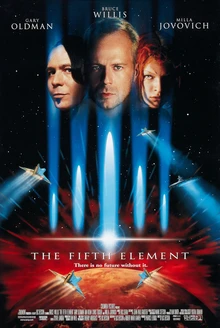
The Convergence
Five elements align, the Darkness falls, and the universe breathes again.

The Convergence is the mythological keystone of The Fifth Element's cosmology: a cosmic realignment that occurs once every 5,400 years, in which the four elemental forces—Fire, Water, Earth, and Air—unite with the Fifth Element, Life itself, to obliterate the Darkness and restore balance to the universe. It is not merely a battle or a ritual; it is a structural reset of creation, a moment when the fabric of existence is rewritten.
In the 1997 film, the Convergence is the engine of every plot thread. Every character's actions—Korben's reluctant heroism, Leeloo's desperate flight, the military's cold logistics—ultimately funnel toward a single question: can the Fifth Element be delivered to the Convergence in time? The event transforms a science-fiction action story into something closer to a creation myth played out on the streets of a neon-drenched 2259 New York.
- Type
- Cosmic mythological cycle
- Frequency
- Every 5,400 years
- Purpose
- Annihilation of the Darkness and restoration of universal balance
- Required participants
- Fire, Water, Earth, Air (the four elements) + the Fifth Element (Life)
- Setting
- New York City, 2259
- Narrative role
- Central plot driver and climactic event
Lore & Background
In the cosmology of The Fifth Element, the universe is not a static machine but a living cycle. The Darkness—the anti-life, the devouring force that unmakes creation—surges in great waves, and each time it does, the elements must converge to push it back. The Convergence is that push: a singular, irreversible moment when Fire, Water, Earth, and Air coalesce around the Fifth Element, which is Life itself, and the combined force erases the Darkness from existence. The cycle then resets, and the universe is given another 5,400 years of stability before the Darkness stirs again.
What makes the Convergence so fragile is that it is not automatic. The Fifth Element is a singular, living being, and it must be physically present, protected, and reunited with the other four elements at the precise moment of alignment. In the film's timeline, the Convergence is imminent, and the Fifth Element—Leeloo—has been scattered, hunted, and nearly destroyed. The entire plot is, in essence, a relay race against a cosmic clock, with the Convergence as the finish line.
The mythology carries a distinctly mythic, almost liturgical tone. The elements are not abstract forces but embodied presences. The Convergence is not explained through physics; it is presented as sacred law, a rhythm older than any civilization. This gives the film's grand spectacle a sense of ancient ritual, as if the audience is witnessing a ceremony that has been performed since the first stars ignited.
In Their Own Story
The sky above the Babel Tower flickered—not with lightning, but with something older. Korben felt it in his teeth, a low hum that had no source, as though the air itself were remembering a word it had forgotten. Around him, the four elemental beings stirred in their respective positions, their forms shifting between solid and light, each one a color that had no name in any human language. And then the Fifth Element walked through the crowd, small and bewildered, her blue skin catching the glow of the convergence building overhead, and the hum became a chord. The Darkness, coiled at the edge of the visible world, shuddered. For one breath, the universe held still. Then it exhaled, and the darkness was gone, and the sky was just sky again, and no one spoke for a long time.
Reader's Guide
Fragment recovered from the Babel Tower archives, undated, author unknown:
They say the cycle is older than the city, older than the ships, older than the word for 'star.' Every 5,400 years the Darkness rises—not as an army, not as a weapon, but as an absence, a hunger that unmakes. And every 5,400 years the elements answer. Fire, Water, Earth, Air. Four forces. Four presences. They gather, and they wait, and they are not enough. They have never been enough. They need the fifth. The one that is not a force but a being. Life. The one who walks, who bleeds, who is afraid.
The last convergence, by our count, was before the old world burned. The one before that, before the old world was old. We do not have records. We have only the rhythm, the 5,400-year pulse, and the understanding that if the fifth does not arrive, the cycle breaks and the Darkness does not retreat. It stays. It grows. There is no record of what that looks like, which is perhaps the worst part.
In 2259, the pulse is here. The fifth is in the city, in a hospital, in a taxi, in a crowd. The four are in place. The clock is not a metaphor. It is a countdown. And everyone in New York, whether they know it or not, is holding their breath for a finish line that has no name except the one the old stories used: the Convergence.
Did You Know?
- The 5,400-year cycle of the Convergence is referenced as a fixed cosmological constant in the film's mythology, making the event in the story the next occurrence after the previous one.
- The Convergence is not depicted as a weapon or a spell; it is presented as a natural cosmic rhythm, closer to a season than a battle, which gives the film's climax a mythic rather than military tone.
- The Fifth Element's role in the Convergence is uniquely personal—unlike the four elemental forces, it is a single living being, which is why the entire plot becomes a rescue and protection story rather than a strategic o
- The film's marketing and title card treat 'The Convergence' as the central noun of the story, positioning the event as the thing the audience is watching happen rather than merely a backdrop for action.
More in Lore & History
Elsewhere in the The Fifth Element universe
Spotted an error? Know more?
This is a living reference — every entry is fact-audited, and reader corrections feed straight into our audit queue. Suggest an edit · See this site's audit record