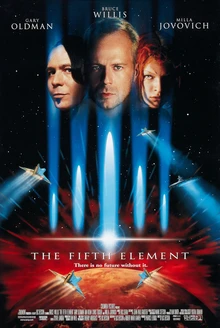
The Creation of the Elements
Four living elements, one impossible force, and a darkness that returns every five thousand years.

The Creation of the Elements is the mythological bedrock of The Fifth Element's cosmology: the origin story of the four elemental incarnations and the Fifth Element, the living force of pure life destined to counter the cyclical threat of Ankhra-Padur. In the film's 2259 setting, this backstory is never delivered as a tidy history lesson. It surfaces in fragments — through the opening narration, through characters who are themselves the elements made flesh, and through the desperate, almost liturgical language used when the unification is finally attempted. Their role is singular and urgent: to reunite and channel a combined force of life capable of annihilating the darkness that returns on a five-thousand-year cycle.
- Ankhra-Padur cycle
- Every 5,000 years
- Elemental incarnations
- Four (Earth, Water, Fire, Air)
- The Fifth Element
- Leeloo (the Angel)
- Purpose
- To generate a 'force of life' that destroys Ankhra-Padur
- Present-day setting
- Earth, 2259
- Nature of the elements
- Living incarnations, not abstract concepts
Lore & Background
In the cosmology of The Fifth Element, the elements are not metaphorical forces but living beings — incarnations with personalities, flaws, and a hard-won humanity. Earth, Water, Fire, and Air each walk among people in 2259, carrying the weight of a purpose they barely understand. The film presents their origin as something older than recorded history, a creation event so ancient it has calcified into myth. No single author or council is named; the elements simply are, as though they were woven into the fabric of the world before the world had a name. What is clear is their function: they exist to be reunited, to fuse into a single 'force of life' that can unmake Ankhra-Padur, the entropy that devours everything it touches and returns with mechanical, terrible regularity every five thousand years.
The Fifth Element — the Angel — is the keystone. Where the four are components, the Angel is the catalyst, the living vessel through which the combined force is channeled. Leeloo is not merely a warrior or a weapon; she is the myth made flesh, the 'I am the Element' declaration that the film builds toward. Her creation is the culmination of the earlier four, the point at which the elements stop being separate and become a single, blazing act of pure life. The film treats this unification almost as a sacrament: the four must be present, willing, and aligned, and the Angel must be whole. Remove any one, and the force collapses, and the darkness wins.
What makes the creation myth resonate with audiences is its deliberate ambiguity. It echoes creation narratives from dozens of world traditions — the binding of chaos, the gathering of primal forces, the birth of a unifying spirit — without pinning itself to any single source. The result feels simultaneously ancient and brand-new, a story the universe tells itself every five thousand years and forgets in between.
In Their Own Story
The chamber was not built; it was grown, its walls a slow crystallization of compressed light that hummed at a frequency just below hearing. Four figures stood at the cardinal points, and the air between them tasted of ozone and salt and woodsmoke and the sharp cold of a mountain peak. Mr. President's hands trembled — not from fear, but from the sheer gravitational pull of being *Earth* in a room that demanded he be more than a man. Ruby's eyes were wet, her water-sense stretched to its limit, reading the emotional weather of three strangers she had never met. Zorg, for once, said nothing. His fire was quiet, banked, waiting. And at the center, the Angel opened her eyes, and the light that poured from her was not light at all — it was *life*, raw and screaming and absolute, the kind of life that had no patience for the slow, grey machinery of the universe. The darkness beyond the walls stirred, tasting the change. It had five thousand years of hunger. It was not ready to be starved. But it was about to be.
Reader's Guide
What follows is a reconstruction, assembled from the fragments the film actually gives us. What is stated explicitly: Ankhra-Padur is a force of destruction that arrives on a five-thousand-year cycle. The four elements are living incarnations — Earth, Water, Fire, Air — and they must be united with the Fifth Element, the Angel, to produce a 'force of life' that destroys Ankhra-Padur. The Angel is described as a being of pure life, the unifier, the keystone. In 2259, the elements are scattered, half-aware, embedded in ordinary lives: a politician, a singer, a corporate industrialist, and a young woman who does not yet know what she is.
What is implied but never fully spelled out: the *who* and *how* of the creation. No deity, council, or engineer is named. The elements simply pre-exist the narrative, as though they were part of the world's original grammar. The film treats their origin as mythic fact, not historical event — you do not interrogate the sun for its birth certificate. The 'creation' is less a dated event and more a standing condition: the elements are, and they will be again, and the Angel will come again when the cycle demands it.
What is left to the viewer: the emotional architecture. Why these four? Why a young woman as the unifier? The film does not answer. It trusts the myth to carry its own weight, and in 2259, in a neon-slicked New York where the sky is a billboard and the dead are recycled into data, that trust is the most radical thing on screen. The elements were not created for a war. They were created for a *promise* — that life, in its full and undivided form, is the one thing entropy cannot digest. The plot of the film is simply the promise being kept, or failing to be kept, in real time.
Did You Know?
- The four elements are not abstract forces but fully realized characters with distinct personalities, professions, and emotional arcs — a politician, a singer, a corporate villain, and a young woman — making the myth pers
- The Ankhra-Padur's five-thousand-year cycle means the myth operates on a timescale that dwarfs human civilization, yet the film grounds it in a single night in a single city, creating a deliberate tension between the ete
- The unification of the elements is presented with the language and staging of a ritual or sacrament — the four must be present, willing, and aligned — rather than a simple power-up, giving the climax a mythic, almost lit
- The film's creation myth deliberately echoes binding-of-chaos and gathering-of-primal-forces narratives found across world traditions without naming any single source, making it feel simultaneously ancient and entirely o
More in Lore & History
Elsewhere in the The Fifth Element universe
Spotted an error? Know more?
This is a living reference — every entry is fact-audited, and reader corrections feed straight into our audit queue. Suggest an edit · See this site's audit record