Canal+
The French channel that bet everything on a girl, a cab driver, and a gun.

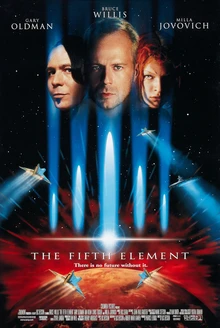
Canal+ is a French pay-television channel and media company, founded in 1984 and headquartered in Paris. For fans of The Fifth Element, it is the institution that made the film possible: Canal+ served as the primary financier and co-producer of Luc Besson's 1997 sci-fi epic, backing a project that was far too ambitious for a conventional French studio budget.
In the broader landscape of French cinema, Canal+ has long been synonymous with auteur-driven, visually extravagant filmmaking. Its willingness to greenlight a multilingual, effects-heavy space opera with an international cast and a score by Eric Serra positioned The Fifth Element as a flagship title for the channel and cemented its reputation as a force that could compete on a global scale.
- Type
- French pay-television channel & media company
- Founded
- 1984
- Headquarters
- Paris, France
- Role in The Fifth Element
- Primary financier and co-producer
- Director of the film
- Luc Besson
- Film release year
- 1997
Lore & Background
In the world of The Fifth Element, the film exists as a cultural artifact born from Canal+'s philosophy: that French cinema should not shrink to fit European comfort zones but should reach outward with spectacle, humor, and heart. Canal+ did not merely write a check; it gave Luc Besson the creative latitude to assemble a multinational cast, build a Parisian New York that no American studio would have financed, and score the whole thing with Eric Serra's instantly recognizable electronic-piano theme.
The channel's involvement shaped the film's DNA in subtle ways. The irreverent tone, the French sensibility toward visual excess, and the insistence on a distinctly non-Hollywood pacing all trace back to a production culture that Canal+ cultivated over its first decade. Where a major American studio might have demanded a tighter three-act structure, Canal+ allowed Besson to breathe, to let the comedy land, to let the action sequences feel almost operatic in their length.
For the fan community, Canal+ represents the 'what if' that never quite materialized: a French studio system producing blockbusters that feel like they were made by artists rather than accountants. The Fifth Element remains the clearest proof that this model could work, and Canal+ remains the name on the production cards that made it real.
In Their Own Story
The studio lot smells of wet concrete and hot coffee. A producer in a rumpled blazer paces the back of a soundstage where a four-story set of 23rd-century Paris is being assembled—neon signage in French and English, a hovering taxi bolted to a hydraulic arm, a wall of green screens waiting to become the void between stars. He holds a script in one hand and a Canal+ production memo in the other. The memo is simple: 'Make it yours. Make it big. Make it French.' He laughs, crumples the memo, and hands the script to a young director who is already arguing with a set designer about the color of a Mib's suit. Outside, Paris rain hammers the studio roof, and somewhere in the city a satellite dish catches a signal that will, in a few years, carry this film to millions of living rooms. The channel's logo glows faintly on a monitor in the corner—just a small, quiet green square in a sea of chaos.
Reader's Guide
Canal+ bankrolled The Fifth Element as a prestige project, giving Luc Besson a budget and creative freedom that no other French entity could match at the time. The channel's in-house production arm coordinated with Les Films du Siècle to manage the shoot across Paris, London, and various studio backlots, ensuring that the film's French identity remained intact even as it aimed at a global audience.
The practical-effects approach—massive physical sets, real props, in-camera stunts—was a deliberate choice aligned with Canal+'s cinema-first philosophy. CGI was used sparingly, mostly for the Mib's faces and the spaceship interiors, while the rest was built by hand. This gave the film its tactile, slightly imperfect texture that fans still celebrate.
Eric Serra's score was composed specifically for the project under Canal+'s production umbrella, and its instantly recognizable opening notes became the film's sonic signature. The channel also handled much of the European marketing and distribution, positioning the film as a French cultural export rather than a Hollywood product.
In its afterlife, Canal+'s involvement is often cited in discussions about French studio financing and the viability of European blockbusters. The Fifth Element remains the channel's most internationally recognized film credit and a touchstone for fans who see it as proof that a French pay-TV network could produce a genuine sci-fi epic.
Did You Know?
- Canal+ was founded in 1984 as one of the first pay-television channels in Europe, and The Fifth Element became one of its most ambitious film investments.
- The film's production was based largely in and around Paris, with the city's architecture and streets doubling for the 23rd-century metropolis, a choice that reinforced its French identity.
- Eric Serra composed the entire score specifically for the project, and the opening piano-and-synth motif became inseparable from the film's identity in audiences' minds.
- The Mib's faces were among the early uses of digital facial animation in a feature film, a technical gamble that Canal+ supported despite the risk of the technology failing on set.
More in Production & Legacy
Elsewhere in the The Fifth Element universe
Spotted an error? Know more?
This is a living reference — every entry is fact-audited, and reader corrections feed straight into our audit queue. Suggest an edit · See this site's audit record