Cinélux
Even in 2259, the world still needs its evening news.

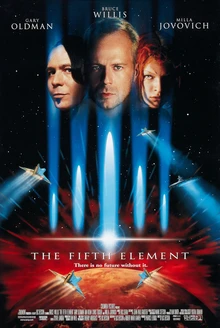
Cinélux is the fictional in-universe news and media network featured in Luc Besson's 1997 film The Fifth Element. It functions as the diegetic broadcaster through which the audience is introduced to the world of New York, 2259, anchoring the film's fantastical setting in a recognizable media format. The name itself is a French-tinged portmanteau evoking both cinema and luminous spectacle, fitting the film's flamboyant visual language.
Though it appears briefly, Cinélux serves a crucial narrative and tonal role: it frames the story's opening events as 'news' to the characters, grounding the extraordinary in the mundane and reminding the viewer that even in a universe of alien elements and interstellar threats, people still flip on the evening broadcast to catch up on headlines.
- Type
- Fictional in-universe news & media network
- Appears in
- The Fifth Element (1997)
- Setting
- New York City, 2259
- Role
- Diegetic news broadcaster; narrative framing device
- First appearance
- Opening news-broadcast sequence
Lore & Background
In the sprawling, vertically stacked metropolis of 2259 New York, Cinélux occupies the role that terrestrial news networks held for centuries: the trusted (if slightly sensationalist) voice delivering the day's events to a populace juggling interstellar politics, corporate espionage, and the occasional alien visitor. Its broadcasts are a staple of the urban soundscape, piped into apartments, transit pods, and the countless holographic billboards that line the city's tiers.
The network's aesthetic reflects the film's broader design philosophy—warm, saturated, and deliberately retro-futuristic. Where other sci-fi universes reach for sterile chrome, Cinélux's identity leans into the colorful, almost baroque visual grammar Luc Besson and production designer Jean-Christophe Lacroix established for the entire film. The news segments feel like a natural extension of the world's pop-art sensibility, as though the network's branding was designed by the same team that gave the city its candy-colored architecture.
For the characters, Cinélux is background texture: something Korben Dallas might glance at while navigating traffic, or a detail that grounds the absurdity of a four-element prophecy in the banal rhythm of daily life. It is the film's quiet reminder that even the most extraordinary stories are, to most people, just another headline between the weather and the sports.
In Their Own Story
The rain hits the glass of the 47th-floor apartment in soft, neon-streaked sheets. Korben doesn't turn on the overheads. Instead, he lets the glow from the street-level holo-boards paint the room in shifting magentas and electric blues. On the small console by the door, the Cinélux evening feed hums to life unbidden, the anchor's voice a low murmur beneath the static: '…and the Council of Stars has voted to postpone the tribunal by another cycle…'
He almost smiles. Almost. The word 'cycle' still sounds absurd, like something a child would say. He reaches over and kills the feed. The silence that follows is louder than the broadcast ever was. Outside, a transit pod shrieks past, its undercarriage trailing sparks. Somewhere below, a vendor is hawking something that glows the color of Leeloo's eyes. Korben pours himself a drink, watches the sparks die, and wonders if the world is any closer to making sense than it was this morning. The answer, he suspects, is no. But the news will still be on tomorrow, and that, somehow, is enough.
Reader's Guide
The in-universe media elements in The Fifth Element—including the Cinélux news segments—were crafted as part of the film's broader commitment to diegetic world-building. Rather than relying on voiceover exposition, the production team embedded narrative information into the world's own infrastructure: billboards, news feeds, and public displays. This approach, championed by Besson and the production design team, made the 2259 setting feel lived-in and commercially saturated, much like a real city.
Practically, the news-broadcast sequences were shot on sets and composited with the film's signature practical effects. The colorful, slightly over-saturated look of the in-universe media matched the overall palette Besson wanted—warm, pop-art, and deliberately un-cinematic in its 'TV' quality. The contrast between the flat, broadcast-style framing and the lush, layered production design of the rest of the film became a recognizable visual signature.
In the film's afterlife, these diegetic media details have become a point of fascination for fans and filmmakers alike. The way The Fifth Element treats its in-universe media as a character in itself—branded, branded, branded—has influenced subsequent sci-fi properties that seek to ground their worlds in commercial and cultural texture. Cinélux, though it never speaks twice, remains a small but telling artifact of that philosophy: the idea that a world is as much about its advertisements and its news as it is about its heroes.
Did You Know?
- The name 'Cinélux' fuses the French word for cinema with 'lux' (light), echoing the film's overall love of luminous, saturated color palettes.
- The in-universe news broadcast serves as the film's primary exposition device, delivering key plot information without breaking the diegetic world.
- The Fifth Element's production design deliberately contrasted the flat, 'broadcast' look of in-universe media with the richly layered, practical sets of the rest of the film, creating a visual hierarchy between 'real' an
- Luc Besson has cited his love of French New Wave and pop-art aesthetics as influences on the film's visual identity, a sensibility that extends into every diegetic detail, including fictional brands like Cinélux.
More in Production & Legacy
Elsewhere in the The Fifth Element universe
Spotted an error? Know more?
This is a living reference — every entry is fact-audited, and reader corrections feed straight into our audit queue. Suggest an edit · See this site's audit record