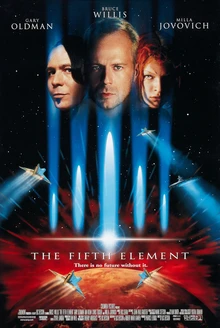
Milla Jovovich
One woman, one orange dress, and a universe that needed saving.

Milla Jovovich's portrayal of Leeloo in Luc Besson's 1997 sci-fi epic The Fifth Element is one of the most visually and emotionally distinctive performances in the genre. At the time of casting, the Ukrainian-born actress was still building her early career, yet Besson saw in her a blend of physical expressiveness and otherworldly innocence that perfectly suited a one-of-a-kind being dropped into a chaotic, color-saturated future New York.
The role became the defining launchpad for Jovovich's international recognition and cemented Leeloo as a lasting icon of 1990s science fiction. Decades later, the character's orange dress, her wide-eyed physicality, and her stumbling attempts at human language remain instantly recognizable, and the film's cult following continues to grow through streaming and retro-culture enthusiasm.
- Character
- Leeloo, the Fifth Element
- Actor
- Milla Jovovich
- Film
- The Fifth Element (1997)
- Director
- Luc Besson
- Production company
- Gaumont (France)
- Actor's background at casting
- Relatively unknown; early-career stage
- Notable skill for the role
- Learned a constructed language (Lingua) for dialogue
Lore & Background
In the world of The Fifth Element, Leeloo is the last surviving member of a species whose very existence is a cosmic counterbalance to entropy. She is not merely a warrior or a diplomat; she is a living mechanism of renewal, a being whose presence can restore balance to a universe tilting toward decay. When she is discovered frozen in a cargo container aboard a freighter, she is essentially a blank slate—powerful, confused, and speaking a language no one on Earth recognizes. Her journey from mute, wide-eyed stranger to a figure who wields devastating energy and ultimately offers a universe-altering choice is the emotional spine of the film.
Her relationship with the bumbling cab driver and ex-soldier Korben Dallas, played by Bruce Willis, is the film's beating heart. It is not a romance built on shared history or mutual understanding in the conventional sense; it is two fundamentally different beings learning to coexist, to protect, and to trust. Leeloo's physicality—her reactions, her confusion, her explosive strength—carries the emotional weight that dialogue alone could not, and Jovovich's commitment to playing the character as genuinely alien rather than merely exotic is what gives the role its enduring resonance.
The broader mythology positions Leeloo as part of a cyclical cosmology: the four classical elements (earth, water, air, fire) require a fifth to maintain equilibrium. She is that fifth, and her story is both a personal awakening and a cosmic event compressed into a single, improbable night in a neon-drenched metropolis.
In Their Own Story
The cargo bay stinks of recycled air and old rust. A technician pries open the container, and the cold mist that pours out freezes the hair on his forearms. Inside, wrapped in a cocoon of pale light, a woman opens her eyes. They are enormous, almost childlike, and they take in the fluorescent tubes, the steel grating, the man in his grease-stained jumpsuit, with the slow, total bewilderment of someone waking in a language she has never spoken. She opens her mouth. The sound that comes out is not English, not French, not any tongue the technician recognizes. It is a small, questioning syllable, and he steps back as though she has said a prayer. She tilts her head. She is not threatening. She is simply, impossibly, new.
Reader's Guide
Luc Besson cast Milla Jovovich when she was still a minor presence in European and American cinema, a deliberate choice to find someone whose face and body could read as genuinely unfamiliar rather than as a known Hollywood star. She spent weeks learning the film's constructed language, Lingua, so that her dialogue felt like a real tongue with grammar and rhythm rather than random gibberish. This commitment gave Leeloo a linguistic identity that audiences still find endearing and strange.
The production leaned heavily on practical sets and in-camera effects wherever possible, with early CGI used for the more fantastical sequences like the floating city and the energy-weapon finale. The film was shot largely in and around Paris, with the futuristic New York built as elaborate stage sets that blended Art Deco geometry with saturated, almost candy-colored lighting. The iconic orange dress was designed to be a single, unforgettable visual anchor in a palette that otherwise shifts through pastels and neons.
The film underperformed at the box office relative to its budget, but it found a passionate second life in home video and, later, streaming. Its influence on 2000s and 2010s sci-fi aesthetics—bright color grading, playful world-building, the blend of action and whimsy—can be traced through numerous subsequent films. For Jovovich, the role opened doors that led directly to her later global fame, and Leeloo remains the character most fans associate with her name.
Did You Know?
- Milla Jovovich was still an early-career actress when Besson cast her; the role of Leeloo was her first major international lead.
- She learned the film's invented language, Lingua, as a structured spoken system rather than ad-libbing sounds, giving Leeloo a consistent 'voice' throughout the picture.
- The orange dress worn by Leeloo became an instant fashion and pop-culture reference point and has been referenced in countless later films, music videos, and cosplay communities.
- The Fifth Element was a commercial disappointment on release but has since grown into one of the most frequently cited cult sci-fi films of the 1990s, with its popularity steadily increasing through the 2010s and 2020s.
More in Production & Legacy
Elsewhere in the The Fifth Element universe
Spotted an error? Know more?
This is a living reference — every entry is fact-audited, and reader corrections feed straight into our audit queue. Suggest an edit · See this site's audit record