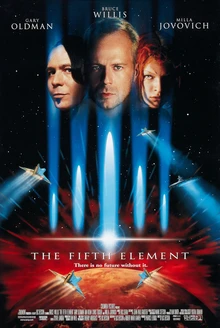
Luc Besson
The French visionary who turned a cosmic myth into a neon-soaked blockbuster.

Luc Besson is the French filmmaker, screenwriter, and producer who conceived, wrote, and directed The Fifth Element (1997), one of the most visually ambitious science-fiction films of the late 1990s. A prolific auteur known for his saturated color palettes, kinetic editing, and love of spectacle, Besson brought a distinctly French sensibility to a Hollywood-scale production, blending operatic storytelling with hard-hitting action sequences.
In the context of the Fifth Element universe, Besson is the architect of its world: the gleaming, multicultural New York of 2259, the spiritual mythology of the four elements, and the irreverent, pop-culture-saturated tone that makes the film feel simultaneously epic and playful. His vision shaped every frame, from the rain-slicked streets to the cosmic ballet of the final battle.
- Nationality
- French
- Role in The Fifth Element
- Director, Writer, Producer
- The Fifth Element released
- 1997
- Born
- Paris, 1959
- Other notable films
- Nikita (1990), Léon: The Professional (1994), The Big Blue (1988)
- Signature style
- Saturated color, kinetic action, operatic scope
Lore & Background
Luc Besson arrived at The Fifth Element after a string of acclaimed French films that established his reputation as a director who treats every frame as a painting. The Big Blue, Nikita, and Léon each demonstrated his gift for pairing intimate character work with large-scale visual set-pieces, and his screenplays were noted for their mythic structure wrapped in contemporary grit. By the mid-1990s, he was ready to scale up to a global production, and the story of a celestial being who must be reunited with her four elemental partners gave him the perfect canvas.
The world he built for the film is deliberately maximalist: a New York that has been lifted off the planet and rebuilt as a floating city, a military bureaucracy that operates with the cold efficiency of a machine, and a spiritual mythology drawn from ancient creation myths but recontextualized in a far-future setting. Besson populated this world with characters who function almost as archetypes—the soldier, the priest, the criminal, the angel—yet gave each one a distinct voice and physicality through his direction of the cast.
His approach to tone is perhaps the film's most distinctive hallmark. Besson refuses to let the cosmic stakes flatten into pure solemnity. Humor, absurdity, and pop-culture references are woven throughout, creating a texture that feels like a comic book brought to life with a $100 million budget. This tonal blend—mythic, comedic, violent, and tender—has become the defining fingerprint of the Fifth Element universe in the eyes of its fans.
In Their Own Story
The soundstage at Pinewood was a cathedral of controlled chaos. Besson stood at the edge of the set, hands clasped behind his back, watching the rain machines hiss to life over the miniature cityscape. The blue glow of the Element's costume caught the studio lights, and for a moment the whole stage smelled of ozone and machine oil. He muttered a correction to the camera operator, then turned to the director of photography and said, in French, that the light needed to feel like a memory rather than a source. The crew reset. The take rolled. And somewhere in the back, a sound designer was already layering a synth note that would become the film's heartbeat. This was how Besson built his worlds—not in one grand gesture, but in a thousand small corrections, each one pulling the image closer to the picture he carried behind his eyes.
Reader's Guide
Éric Serra composed the orchestral-electronic score for The Fifth Element, and Besson worked closely with him to ensure the music felt both ancient and futuristic. The theme for the Element blends choral textures with pulsing synths, giving the character a sonic identity that feels mythic without being operatic. Serra's score became inseparable from the film's emotional arc and has since been used in countless fan edits and tribute pieces.
Besson insisted on a heavy practical-effects foundation for the film, building large-scale sets, miniatures, and animatronic elements before layering early CGI on top. The floating city, the spaceship interiors, and the final space battle all relied on physical models and matte paintings, which gave the film a tactile, handcrafted quality that pure digital work of the era often lacked. This hybrid approach contributed to the film's distinctive visual texture—slightly grainy, warmly lit, and dense with detail.
Principal photography took place largely in London, with additional work in other European locations. The choice to shoot in the UK gave the production access to major studio infrastructure while preserving a European creative crew, which Besson felt was essential to maintaining the film's particular voice. The result is a film that, despite its Hollywood cast and budget, carries a distinctly French authorial fingerprint in its pacing, color grading, and narrative structure.
Upon release, The Fifth Element received mixed reviews from critics but found a passionate audience among viewers who appreciated its visual exuberance and tonal freedom. Over the following decades, it cultivated a devoted cult following, and Besson's direction is now widely credited with creating one of the most visually distinctive sci-fi universes of the 1990s. The film's influence is visible in the saturated color palettes and comic-book energy of numerous later action and sci-fi projects.
Did You Know?
- Besson wrote the screenplay for The Fifth Element himself, building the four-element mythology from scratch before assembling the cast around it.
- The film's production design leaned heavily on physical miniatures and matte paintings, with CGI used as an enhancement layer rather than the primary tool—a deliberate choice to preserve a tactile, handcrafted look.
- Besson has cited ancient creation myths and the concept of elemental balance as the narrative backbone, framing the story as a modern retelling of an archetypal cosmic cycle.
- Despite its mixed initial critical reception, The Fifth Element has grown into a cult classic, with its visual style and tonal blend continuing to influence action and sci-fi filmmaking two decades later.
More in Production & Legacy
Elsewhere in the The Fifth Element universe
Spotted an error? Know more?
This is a living reference — every entry is fact-audited, and reader corrections feed straight into our audit queue. Suggest an edit · See this site's audit record