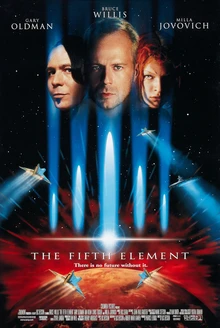
Eric Serra
One man, one studio, and a symphony of pink, neon, and impossible joy.

Eric Serra is the French film composer whose score for Luc Besson's 1997 sci-fi epic *The Fifth Element* became one of the most distinctive and beloved soundtracks in the genre. Working closely with Besson across several projects, Serra crafted a musical landscape that fuses synthesizer-driven electronic textures, lush orchestral swells, world-music inflections, and pop-inflected melodies into a single, wildly eclectic tapestry. His score is as much a character in the film as its protagonists, underscoring the story's blend of humor, spectacle, and genuine emotional warmth.
For fans of the film, Serra's music is inseparable from the visual world Besson built: the pink of Leeloo's dress, the chaos of the New York skyline, the tenderness of a kiss in a rain-soaked alley. Serra's work gave the film its emotional spine, and decades later, the score continues to be rediscovered by new audiences who encounter it through streaming, remixes, and the enduring cult following of the movie itself.
- Role
- Film Composer / Score
- Nationality
- French
- Key Collaboration
- Luc Besson (multiple feature films)
- Film
- The Fifth Element (1997)
- Musical Style
- Electronic-orchestral-pop fusion with world-music influences
- Notable Fellow Besson Scores
- The Big Blue (1988), The Ladykillers (1995)
Lore & Background
Serra's approach to scoring *The Fifth Element* was characteristically maximalist. Where many sci-fi scores of the era leaned on cold, atonal minimalism, Serra reached for warmth, humor, and sheer sonic variety. A single cue might shift from a driving synth bass line to a full string section to an almost folk-like melodic hook, mirroring the film's own refusal to commit to a single visual or tonal register. The result is a score that feels simultaneously futuristic and deeply human, which is precisely the paradox at the heart of Besson's story about a being of pure light navigating a world of grime and bureaucracy.
Serra's long working relationship with Besson meant a shared vocabulary of emotional storytelling. Both filmmakers trusted music to carry scenes that dialogue could not, and Serra's instinct for timing—knowing when to let a melody breathe over a wide shot of the city and when to let a percussive hit punctuate a comedic beat—gave the film a rhythmic energy that few sci-fi pictures of the late nineties achieved. The score's recurring motifs, particularly the warm, almost lullaby-like theme associated with Leeloo, became shorthand for the film's central argument: that love, in all its clumsy and glorious imperfection, is the ultimate evolutionary force.
In the years since release, Serra's score has acquired a life of its own. It has been sampled, remixed, and referenced in everything from video game soundtracks to fan-made orchestral arrangements. For a generation of fans who grew up with the film, hearing the opening synth arpeggio is enough to summon the entire world: the pink dress, the four elements, the rain, the kiss, and the sense that the universe is, against all odds, worth saving.
In Their Own Story
The studio smells of cold coffee and ozone. Outside the window, Paris is a smear of grey November rain, but inside, the monitors glow with waveforms that look like the skyline of a city that doesn't exist yet. Serra presses play. A synth line rises—warm, slightly detuned, almost laughing—and beneath it, a cello enters like a whispered secret. He nods, frowns, adjusts a knob. The melody should feel like a woman stepping out of a bath for the first time, like a city waking up under a sky the color of a bruise healing. He layers a hand-drum pattern, then pulls it back. Too much. The film needs room to breathe, needs the audience to feel the weight of a single pink petal drifting through a corridor of chrome and glass. He saves the file. Somewhere in the cut, a man in a tattered coat is about to fall in love with a being made of starlight, and the music has to make that impossible thing feel as inevitable as gravity. Serra leans back, exhales, and lets the last note ring out into the wet Parisian dark.
Reader's Guide
Serra's score for *The Fifth Element* was composed with a deliberate philosophy of genre collision. Rather than committing to a purely orchestral or purely electronic palette, he treated the film's narrative shifts—comedy, action, romance, spectacle—as cues to swap musical registers mid-phrase. A chase sequence might pivot from staccato brass to a sweeping synth pad, and a quiet moment between two characters could be underscored by a single, slightly out-of-tune guitar. This approach gave the film a restless, almost jazz-like energy that set it apart from the more monolithic scores of its contemporaries.
Practically, Serra worked in a hybrid studio environment, blending live orchestral recordings with synthesizer and electronic production. This allowed him to achieve the film's signature sound: the warmth of acoustic instruments married to the shimmer and precision of digital sound design. The result is a score that feels both handcrafted and technologically forward, much like the film's own mix of practical sets and early-90s digital effects.
In terms of legacy, the score has endured well beyond the film's initial box-office performance. It has been reissued, sampled, and referenced across media, and Serra's name has become synonymous with a particular brand of French pop-cinema sound that values emotional directness and playful eclecticism over cold genre purity. For fans, the soundtrack remains the emotional key to the entire film—play it in the right order, and the story tells itself.
Did You Know?
- Serra had a long-standing creative partnership with Luc Besson, scoring multiple of his features over the course of a decade, which gave him an intimate understanding of Besson's visual and narrative rhythms.
- The score for The Fifth Element is notable for its deliberate refusal to sound like a 'typical' sci-fi soundtrack, instead drawing on pop, world music, and orchestral traditions to create a uniquely warm and humorous son
- Serra's music for the film often functions as a narrative character in its own right, with recurring melodic motifs tied to specific characters and emotional beats, much like a traditional film-music leitmotif system.
- The eclectic, genre-blending approach Serra took with the score has influenced a generation of French and international film composers who prioritize emotional warmth and musical variety over genre convention.
More in Production & Legacy
Elsewhere in the The Fifth Element universe
Spotted an error? Know more?
This is a living reference — every entry is fact-audited, and reader corrections feed straight into our audit queue. Suggest an edit · See this site's audit record